
Published by Baker Academic on August 4, 2026
Genres: Academic, Non-Fiction, Theology
Buy on Amazon
Goodreads

This updated edition of a contemporary classic teaches sound grammatical, lexical, cultural, and theological Bible study practices, offering expert guidance for those seeking to interpret Scripture more accurately.
D. A. Carson and Andrew David Naselli teach interpreters to think critically and to develop sound reasons for the choices they make. To do this, interpreters must reject unsound reasons; so the authors identify common mistakes many Bible interpreters make and how to avoid them.
The third edition is significantly expanded, examines some new fallacies, and is accessible for beginning students of theology. It is also a helpful resource for any student of biblical languages.
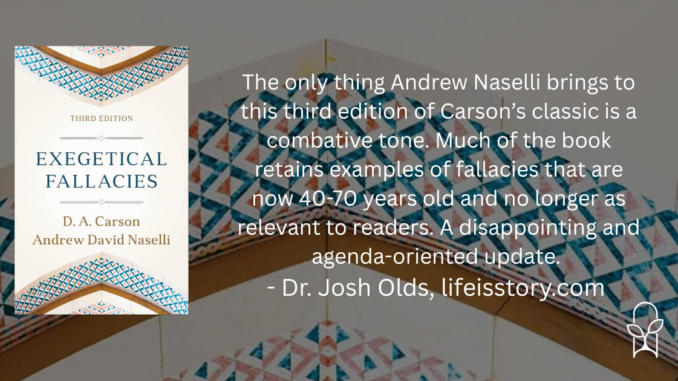
One of the most obvious ways to evaluate the third edition of a book is whether or not it was necessary. Why not just reprint the second edition? What new content is added? What old content is excised? How is the book made better or different? D.A. Carson’s Exegetical Fallacies was first published in 1984. It was Carson’s second book in what would be a prolific career as a New Testament scholar and Christian academic. He updated the book a bit in 1996—a minor update by his own admission—but now thirty years have passed. What does the 3rd edition of Exegetical Fallacies bring us?
First, it brings us a new coauthor in Dr. Andrew Naselli. Naselli holds PhDs from Bob Jones University and Trinity Evangelical, during the latter of which Carson was his supervisor. In the preface to the third edition, Naselli writes that Carson—now professor emeritus—asked him to be a part of updating the text for a third edition. I’ll give Naselli come credit: he makes the book more accessible by updating its format and style.
But it’s quite difficult to read a book about interpreting Scripture in an unbiased manner from a guy whose teaching and pastoring style has been framed as spiritually abusive with students claiming he encouraged a “hyper-competitive environment” where “mocking one another’s position’s…was encouraged.” Exegetical Fallacies does nothing to dissuade me of the legitimacy of these claims, because that’s rather how Naselli comes across here.
Second, the third edition brings us directly into the conservative culture wars. The book’s conservative lean should be obvious from the outset given the authors—Carson founded The Gospel Coalition and Naselli is a professor at John Piper’s seminary—but Naselli leans into it from page one where he compares working with Carson to being a law clerk working for Justice Clarence Thomas. Naselli’s additions to the book, the examples of fallacies he adds, are almost always on a culture war issue and rarely contextual or necessary. Naselli uses Exegetical Fallacies not so much to outline types of exegetical errors, but to take jabs at viewpoints he does not agree with.
The most egregious example of this is in the discussion of a false binary. Carson’s first and second edition texts begin with a now horribly-dated and obscure reference to mid-20th century views on the 144,000 in Revelation. That is retained in the third edition, but Naselli adds in two entire pages of an example that does not even come from Scripture. Naselli introduces the section on the false binary like this: “When a parent has a daughter who has imbibed LGBT+ ideology, claims to be male, and wants to undergo surgery that irreversibly alters her body, counselors may press a parent by asking, ‘Would you rather have a dead daughter or a living son?’”
Let’s put aside how poorly written that sentence is or how it assumes gender-affirming surgery is readily available to minors. It is true that dead daughter/living son is a false binary. It does not inherently follow that transgender males must commit suicide or otherwise die if they do not receive surgical gender-affirming care. It may make suicidal ideation more likely or increase the possibility of negative mental health outcomes, but the binary is false.
However, what Naselli fails to point out is that the dead daughter/living son argument is intended as emotional hyperbole, not a logical argument. It is not intending to be a logical binary. Naselli has made a category error by treating a rhetorical question as formal logical argument. He is committing a straw man fallacy. Further, there is delicious irony in using an example where Naselli demands a strict binary (male or female) to illustrate a false binary. One could just as easily present Naselli’s view of gender as a false binary. In an argument where he chides people for making binaries where there aren’t any, Naselli does precisely the same thing.
Beyond this, nothing much has been updated since Carson’s first edition. This means, when not engaging in the modern culture wars, the majority of the fallacies cited in the book are from scholars in the mid-20th century. Rather than engaging with the most recent scholarship, a lot of Exegetical Fallacies finds its examples from 40-70 year old scholarship. Needless to say, a lot has changed in New Testament studies since then and while Carson might have been responding to relevant, timely examples forty years ago, to have not updated these examples is just lazy.
This third edition of Exegetical Fallacies is only here to be combative, create controversy, and mock viewpoints Naselli disagrees with. By focusing on fallacies, Naselli and Carson are able to present (or misrepresent) their opponent’s worst arguments and tear them apart without ever having to consider better and more widely used arguments. The goal of this book is purportedly to teach us how to read Scripture better. It does not do that.