
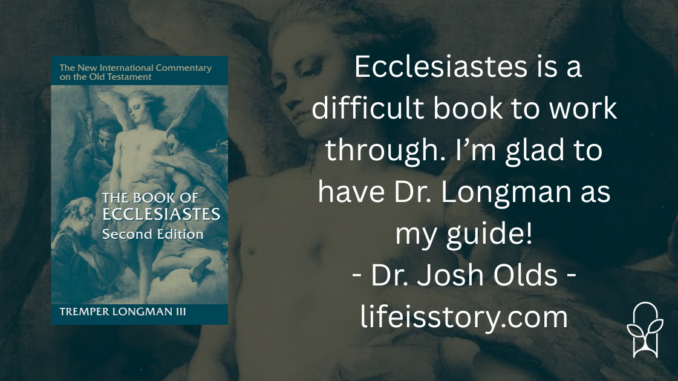
Also by this author: The Bible and the Ballot: Using Scripture in Political Decisions
Series: NICOT
Published by Eerdmans on February 26, 2026
Genres: Academic, Theology
Buy on Amazon
Goodreads

A trustworthy guide―newly updated and expanded―to the book of Ecclesiastes
Ecclesiastes is one of the most perplexing and haunting books of the Old Testament. The main speaker in the book, a figure known as Qohelet, ponders a question that people are still asking today: “Where can we find meaning in the world?” But while the question itself is familiar, devout readers of Scripture may find Qohelet’s answer startling. “Meaningless,” says Qohelet, “everything is meaningless.”
For readers seeking to understand how this deeply pessimistic perspective fits into the rest of biblical revelation, Tremper Longman III’s commentary on Ecclesiastes is a trustworthy guide. In this updated edition, Longman maintains his canonical-Christocentric approach to interpreting Ecclesiastes but expands his discussion of secondary literature by engaging with recent scholarship from a wide range of authors―Stuart Weeks, John Goldingay, Arthur Keefer, Knut Heim, George Athas, and many others.
Longman first provides an extensive introduction to Ecclesiastes, exploring such background matters as authorship, language, genre, structure, literary style, and the book’s theological message. He argues that the author of Ecclesiastes is not Solomon, as has been traditionally thought, but a writer who adopts a Solomonic persona. In the verse-by-verse commentary that follows, Longman helps clarify the confusing, sometimes contradictory message of Ecclesiastes by showing that the book should be divided into three sections―a prologue (1:1–11), Qohelet’s autobiographical speech (1:12–12:7), and an epilogue (12:8–14)―and that the frame narrative provided by prologue and epilogue is the key to understanding the message of the book as a whole. This carefully researched commentary is an essential resource for pastors, seminary students, and thoughtful readers of Scripture.
The New International Commentaries are my first-stop resources when deeply studying any biblical text. They have been the evangelical standard for fifty years now, collecting the very best research from top-notch scholars to produce a commentary that stands between lay-level explanation and academic exegesis. It does an excellent job of balancing the academic and the applicational—not getting so bogged down in the text that it forgets to address its meaning to us today. NIC treats the Bible appropriately as ancient literature, but not just as ancient literature, still seeing it as part of God’s revelation to humankind.
The New International Commentary on the Old Testament (NICOT) volume for The Book of Ecclesiastes was written by Tremper Longman III and published in 1998. This newly-published second edition also comes from Dr. Longman and includes an expanded bibliography, updated footnotes, a longer introduction, more excursive and applicational commentary, and interaction with modern scholarship on Ecclesiastes. Longman doesn’t change or recant anything, but argues with a depth and clarity that comes with 25 more years of research and thought.
The second edition also reflects the changes to Ecclesiastes scholarship since the 90s. Specifically, Longman’s “two voices” reading of the text was more of a minority position in the 90s, but is now more accepted as accurate. He also talks more extensively about the date of writing of Ecclesiastes, which he has as quite late in the Hellenistic period.
I should also talk about Tremper Longman III’s bona fides. His doctorate is in Ancient Near Eastern studies from Yale and he spent his career studying and teaching the Old Testament. His specific academic expertise has been the wisdom literature, where he’s contributed commentaries to not only Ecclesiastes but Song of Solomon, Lamentations, Psalms, and Proverbs. His Song of Solomon commentary is also with NICOT, making him the perfect person to complete the “Solomonic” books.
Because Longman also wrote the first edition and his views have not drastically changed, there’s little on the side of application that is significantly updated. For example, in his first edition commentary on Ecclesiastes 1:4 covers eight paragraphs. In the second edition, those same eight paragraphs are lightly edited but mostly verbatim followed by a ninth paragraph discussing scholarship not available in 1998. The bulk of the update comes in the book’s preface and general introduction. Twenty-five years later, it was certainly time for an update, but I would have liked to have seen more emphasis on interacting with recent scholarship versus what I could already read from the first edition. This is definitely worth getting if you don’t have the first edition. If you do, then it’s probably only worth it if you too are an OT biblical scholar.
One of the most interesting things I learned from Longman here is his framing of Ecclesiastes as having “two voices.” The first voice is Qohelet, the main speaker throughout most of the book, whose reflections often emphasize life’s futility, uncertainty, and inability to provide lasting meaning “under the sun.” The second voice is the frame narrator who introduces Qohelet in Ecclesiastes 1:1–11 and concludes the book in 12:9–14. Longman argues that the narrator does not fully endorse Qohelet’s pessimistic conclusions but instead uses the epilogue to correct and reframe them, directing readers toward reverence for God and obedience as the proper response to life’s limitations. In this reading, Ecclesiastes intentionally preserves the tension between human frustration and faithful trust in God.
This differs significantly from the traditional interpretation that Solomon himself wrote Ecclesiastes to express his own inspired wisdom. Longman argues that Qohelet is a literary persona—likely modeled after Solomon rather than literally being Solomon—and that the book intentionally distinguishes between Qohelet’s perspective and the narrator’s final evaluation of it. Rather than treating every statement in the book as the author’s endorsed viewpoint, Longman sees Qohelet’s speeches as a partial and sometimes flawed exploration of life “under the sun,” which the narrator ultimately reframes in the epilogue by emphasizing fear of God and obedience.
Overall, I can’t say that I had dove much into Ecclesiastes as a pastor. I’m glad that this second edition’s release gave me the opportunity to spend a week to do so. Ecclesiastes is a difficult book to work through. I’m glad to have Dr. Longman as my guide!