
Published by Eerdmans on June 4, 2026
Genres: Non-Fiction, Biography
Buy on Amazon
Goodreads

Meet the Reverend Mother Ruth, a Black Protestant nun whose call to ministry would challenge and change the Episcopal Church
The Strain of Other Blood tells the true story of a trailblazing Black Protestant nun. Born in Harlem in 1897, Ruth Elaine Younger sought to break away from her impoverished and turbulent family life and join an American Episcopal order. She was denied admission because of racial discrimination in the Episcopal Church, so she moved to Toronto and became a nun in the Anglican Church of Canada. But she never gave up her dream of living out her vocation in America, and her persistence eventually opened a path back to New York City, where she founded an Episcopal order for women and a private K–8 school in 1950 that is still flourishing today.
Mother Ruth was a fascinating figure with a complex relationship to racial identity: on the one hand, she advocated passionately for multicultural faith and learning communities, while on the other hand, she sometimes passed as white when doing so enabled her to achieve her goals more effectively. She was also a controversial leader who maneuvered around the rules of the institutional church to achieve the goals to which she felt God was calling her. With compelling and candid storytelling, The Strain of Other Blood introduces readers to an unexpected civil rights advocate who was ahead of her time both in the church and in society.
This is one of those books that came to me unsolicited from the publisher and I will admit that, even had I known about the book, it’s not one that I would’ve actively sought to review. The Strain of Other Blood is a historical biography of a person I’d never heard of from an author I’d never heard of focused on a church denomination I’m not a part of and particularly about a part of that denomination many don’t realize exist. More specifically, it’s a biography of a Reverend Mother Ruth, a Black Episcopalian nun in the 20th century, whose life and ministry was full of complexity.
It’s one of those hyper-specific biographies that will make more sense to those within the context or who have a greater connection to the biographed individual and their context. But even to me, absent all of that, it was an interesting journey into the complex world of being a Black woman in ministerial leadership during the mid-1900s. Allen is a consummate researcher and the book is, at points, as much a memoir of her research journey as it is about the Reverend Mother, offering a comparison in contrast between two generations of Black Episcopalian women.
The early chapters of The Strain of Other Blood are a bit rough. There just isn’t a whole lot of surviving information about Ruth’s childhood or adolescence to write about. Allen instead focuses on telling the story of her research journey—how she tracked down surviving relatives, connected with them, and learned what they knew about Mother Ruth. Ultimately, though, Allen always had more information than they did and the lack of information or remembrance simply serves to underlie how history can be forgotten.
You also get an early suspicion that Mother Ruth is a complicated figure. She has a demanding, no-nonsense attitude that blossoms once she is able to obtain leadership power. By the second half of the book, Allen has moved into Ruth’s later and more well-documented ministry as head of a school in New York that grew to be rather prestigious. There’s a whole chapter about how Madeliene L’Engle’s children attended there with L’Engle being part of the school for some time as her own fame began to grow.
Overshadowing all of this is Sister Mary’s complicated relationship with race. As the title The Strain of Other Blood might imply, Mary was biracial—biracial to the point of being White-passing, in fact. The title of the biography refers to Mary’s own term for her racial heritage. Mary was Black, yes, but her Blackness was also an “other.” Through the book, we see that as Mary obtains more power, she becomes Whiter—being marked as such on census forms and downplaying any connection to her Blackness. At one point in the biography, Allen relates talking to a Black former student at the school, now nearing their 70s, who was shocked to learn that their former headmistress was Black.
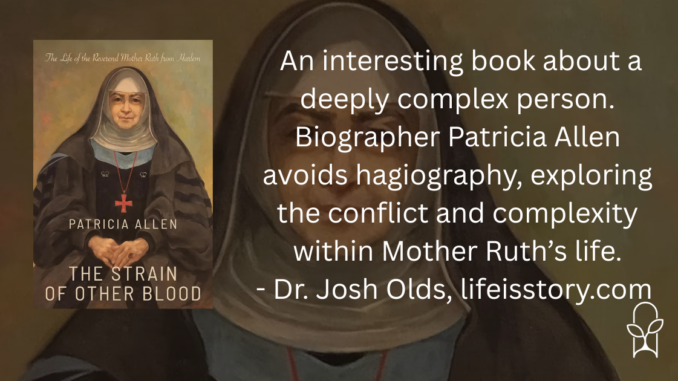
Allen also avoids hagiography, presenting Mother Ruth as a complicated authoritarian figure. Most of the former students she spoke with did not have fond memories of Ruth, instead pointing to her harsh disciplinarian nature. The final chapters detail Ruth’s final years, where she is forcibly ousted from control of the school, mistreats her caretakers, and refuses to reconcile with family. Yet, despite this, Allen seems to view Ruth as a positive figure with a strong faith and a determination to follow what she felt was God’s will.
There are definitely things I wish The Strain of Other Blood had done differently. Based on the title, I thought there would be more depth to the discussion of Ruth’s Blackness and her relationship to her ethnic heritage. It certainly seems to me that Ruth believed that the best way to succeed in life was to downplay her ethnic and familial background and become White. Was Ruth simply pragmatic? Did her pragmatism here lead to her obsessive authoritarianism elsewhere? Was her treatment of Black students as a school leader based on the trauma of racism in her past? There’s a lot to explore here that Allen, by focusing only on the biographical elements, touches on but never explores in much depth.
Allen also inserts herself into the biography at many points, weaving somewhat of a twin narrative of biography and memoir—a biography of Mother Ruth and a memoir of Allen’s experience in researching Ruth’s story. As Allen herself is a Black Episcopalian operating in majority White spaces, including spending time living in a convent, she has a similar experience with Ruth in being a racial minority within a religious order. Allen speaks about the troubling experience of living in a room termed a “cell” while being subject to someone called a “superior” and forced to live under strict guidelines while researching part of her book. This tie back to Ruth’s own experience and their shared racial trauma of ancestral enslavement forms a powerful concept within the book that Allen doesn’t develop in fulness.
All that said, it’s an interesting book about a deeply complex person that—as the length of this review shows—has led me to some deep thinking and reflection. If you have an interest in Mother Ruth, in Episcopal religious orders more broadly, or in women in religious leadership even more broadly, this may be something you would enjoy.