
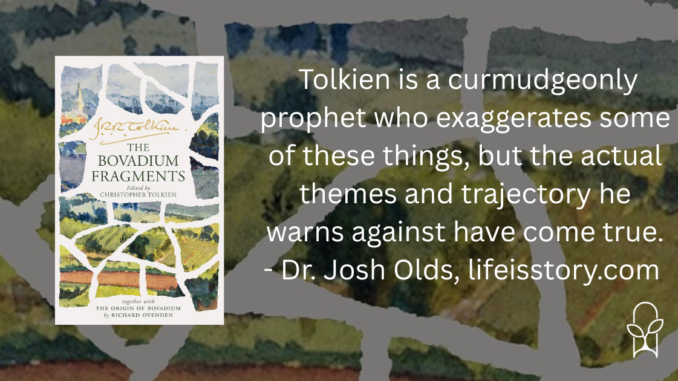
Also by this author: The Battle of Maldon: Together with the Homecoming of Beorhtnoth, The History of the Hobbit, The Lay of Aotrou and Itroun, The Story Of Kullervo, Pictures by J.R.R. Tolkien
Published by HarperCollins on October 9, 2025
Genres: Fiction, Short Form, Speculative
Buy on Amazon
Goodreads

The first-ever publication of a previously unknown short satirical fantasy by J.R.R. Tolkien, edited by his son, Christopher Tolkien, and accompanied by illustrations from the author together with an essay, "The Origin of Bovadium," by Richard Ovenden OBE.
As Christopher Tolkien notes in his Introduction, The Bovadium Fragments was a "satirical fantasy" written by his father, which grew out of a planning controversy that erupted in Oxford in the late 1940s, when J.R.R. Tolkien was the Merton Professor of English Language and Literature.
Written initially for his own amusement, Tolkien’s tale was a private academic jest that poked gentle fun at the pomposity of archaeologists and the hideousness of college crockery. However, it was at the same time expressing a barbed cri de coeur against the inexorable rise of motor transport that was overwhelming the tranquility of his beloved city. Interest in publishing it in the 1960s ultimately foundered, and the text remained hidden for 60 years.
Depending on who you ask, the Tolkien estate is either unearthing mithril or have delved too greedily and too deep. Despite having passed in 1973, Tolkien still manages to produce several books per year—all new editions or deluxe editions or updated illustrated editions. What we don’t get, though, is something new. The man’s been dead for fifty years, after all. Except here we are with The Bovadium Fragments, a short satirical fantasy written by Tolkien and never published until now.
It makes you wonder: “Is there a reason it hasn’t been published until now?” Surely with audiences and collectors clamoring for Tolkien content, something new and publishable would be immediately presented to the world. It was written at some point in the late 1940s and made its way to potentially publishable in the mid-1960s after Tolkien’s success with Lord of the Rings. However, The Bovadium Fragments liberal use of Latin and wry subject matter caused him to ultimately shelve it.
The Bovadium Fragments is last work by Tolkien to have been approved and edited by his son and literary executor, Christopher Tolkien. The book begins with an introduction by him and carries his footnotes and editing. Being a short work, it’s also accompanied by The Origin of Bovadium, a historical look at the major roadworks project that completely redesigned Oxford for motor vehicles and which served as Tolkien’s inspiration for the book. This section is written by Richard Ovenden, the Bodley’s Librarian and the Director of University Libraries.
The Bovadium Fragments is written as if it is a text that has been excavated by far-future archaeologists seeking to understand the Oxford of a much different past. The problem is, of course, motor vehicles. Tolkien was not a fan of mechanical technology—just see his characterization of Saruman in The Lord of the Rings—but especially hated cars. He even dedicated a whole children’s book, Mr. Bliss, to the subject.
The fragments discovered reveal—with a sardonic humor—how motor cars came to dominate the landscape and how humanity began to be willing servant of the Machine. Suffice it to say that Tolkien would die all over again if he was resurrected and taken to modern-day Oxford (let alone some car-centric place like Dallas, Texas). It’s interesting to see how many of Tolkien’s predictions have come true: pollution, traffic jams, the desecration of nature, the speeding up of life, the pushing of capitalism to extremes. Tolkien is really a curmudgeonly prophet who exaggerates some of these things, but the actual themes and trajectory he warns against have come true.
There’s a tendency to look at older folk unwilling to fall in line with new technology as wistful, even spiteful of youth and progress. Tolkien doesn’t come across this way at all. Instead, he writes as someone who has seen that technological progress has often led only to better and more efficient forms of destruction. The Bovadium Fragments, in that way, is a rather personal look into Tolkien’s thinking, his humor, and his love of the land, nature, and even Oxford. It’s a pleasant and enjoyable addition to the Tolkien canon.