
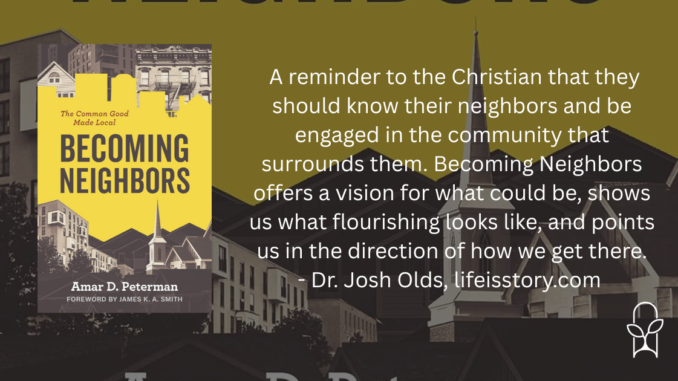
Published by Eerdmans on March 12, 2026
Genres: Non-Fiction, Christian Life
Buy on Amazon
Goodreads

The work of cultivating the common good starts in your own neighborhood.
In Becoming Neighbors, Amar D. Peterman explores how the common good can be cultivated through the practice of neighbor love. And he encourages Christians to join their neighbors at what he calls “the shared table”―a space where communities gather across differences to work towards the flourishing of the whole.
Within every neighborhood, people have daily opportunities to show up for each other and share the best of their traditions, cultures, and beliefs. But too often, Christians keep to themselves―and when they do show up, many spend more time talking than listening. Peterman encourages Christians to adopt a different posture: to sit side by side with their neighbors at the community table, share a meal, engage in mutual listening and learning, and actively commit to each other’s flourishing.
Peterman illuminates the faith-based insights that Christians can bring to the table, such as the biblical call to love others, to seek goodness, and to build communities of belonging. And he offers tangible practices of neighbor love―including compassion, resonance, lamentation, and accompaniment―that translate across diverse populations. Peterman also demonstrates how Christ’s example as prophet, priest, and king serves as a guide for how Christians might live faithfully in their communities today.
At the heart of this book is a simple but critical question: How will we live? Amid our differences and disagreements, through the strife and terror of our world, through the reality of death and the hope of resurrection, the answer for Christians is clear: We live as neighbors.
I read this book sitting in my open garage, listening to my young daughter play with the neighbor kids across the street as my son played with the neighbors next door. At one point, another group of kids from down the road a ways joined in and for a little bit they were all here in the garage with me building a fort out of blankets and turned over bar stools. Amar Peterman’s Becoming Neighbors is a succinct blueprint for community building, a desperately-needed resource in an often disconnected world. But as I read the book and listened to the sounds of kids all around me, I realized that what Peterman is promoting is really just a re-realizing of that community and camaraderie we had as children.
In the first chapter of Becoming Neighbors, Amar details the difficulty of intentional hospitality. He centers Christian work around this practice, specifically pinpointing how the early gathered at the Communion table not only as a spiritual practice but for real food and connection. The second chapter expands this movement out beyond the church to the neighborhood, insisting that Christians and their churches are called to minister within the place they are set. And this does not mean ruling over or dominating the landscape, but joining in with other organizations and faiths and congregations to develop a diverse and flourishing neighborhood for all people.
Chapters three and four move into a deeper discussion of how the church builds this community, offering reflections on lament, humility, compassion, accompaniment, and more. The principles that Becoming Neighbors addresses aren’t novel or surprising, but they can be difficult to begin. Peterman calls for a sharing of self in which the community is then able to do more than any one person ever could. The final chapter then ties everything together in a concluding exhortation to live as neighbors.
Weighing in at 87 pages, Becoming Neighbors is a short work of exhortational theology. There’s a passion and fervency that exudes out of Peterman’s words that make this becoming neighbors thing just seem so obvious and easy. Of course, if that was the case, there’d be no need for the book. I would have loved to have seen a chapter addressing the problems of neighboring—the difficulty in developing a diverse community or bringing folks together who think differently. I would have liked for Peterman to have addressed Western individualism and the ways in which our infrastructure minimizes communal spaces and make community more difficult.
But for what it is, it is amazing. A breath of fresh air. A reminder to the church to be engaged in the place in which they are set. A reminder to the Christian that they should know their neighbors and be engaged in the community that surrounds them. Becoming Neighbors offers a vision for what could be, shows us what flourishing looks like, and points us in the direction of how we get there.