
Published by Baker Academic on April 7, 2026
Genres: Academic, Non-Fiction, Theology
Buy on Amazon
Goodreads

In Bonding with God, Victor Counted uses the attachment framework to explore how we develop psychological bonds with God, what sustains those bonds, and what can erode them, leading to a crisis of faith.
As we navigate questions of identity, meaning, and purpose, the role of faith in offering support and guidance becomes crucial. Yet the emotional and psychological aspects of religious experience are often overlooked. Counted fills this gap by showing how a caregiving faith can foster resilience and spiritual transformation.
Bonding with God is a fascinating read that challenges traditional notions of religion and spirituality and invites us to examine our own connections with God. It is a valuable resource for mental health professionals and students training for ministry or caring professions who seek to understand how individuals form, maintain, and navigate emotional bonds with God.
Counted's interdisciplinary approach, combining psychology and theology, makes this book an essential resource for anyone interested in the intricacies of human attachment and the power of faith to shape our lives.
Attachment theory is a psychological framework pioneered by 20th century British psychoanalyst John Bowlby. He posited that the emotional bonds formed with primary caregivers in infancy would highly inform that infant’s capacity for trust, intimacy, and emotional regulation as an adult. Attachment theory posits four different styles of attachment: 1) secure, 2) anxious, 3) avoidant, and 4) disorganized. In Bonding with God, Victor Counted moves attachment theory from the parent-child relationship to the spiritual arena to consider attachment theory’s connection to how one bonds with God.
Counted’s writing is based on a research study that he did in South Africa, engaging young people to collect data on their relationship experiences with God. While this makes Bonding with God more than theory, it does bound Counted’s research into some rather tight limitations. First, Counted’s direct experiences are with a group of 100 young South Africans in 2014-2015. This likely represents a much different group than Counted’s core audience for Bonding with God and, at the point of the book’s publication in 2026, is a bit dated. (It would have been nice, though maybe impractical for Counted to have done a more recent follow-up with his study’s participants to evaluate any changes in the decade since their original responses.) Despite these limitations, Counted’s study is still solid—attachment theory works across time and culture—and holds value for readers today.
The initial chapters of the book introduce attachment theory and do the work of transplanting it into a spiritual paradigm. Bonding with God makes the case for Christianity as a care-giving faith and the central aspect of the religion a relationship between God and people. Counted explores how people seek attachment with God through prayer, worship, ritual, Scripture reading, etc. He also explores God as a source of comfort in difficult times, reflecting on how people react to God when hard times come.
The middle part of the book gives deeper into attachment theory, with chapters spent exploring how God can serve as a secure base, how people can become disconnected (and reconnected) with God, and what causes people to question or detach from faith. Throughout it all, Counter really allows his participants to speak, trusting his phenomenological methodology to connect readers to the joys and struggles of his participants.
If you’re reading this review on the website on which it was originally published, you’ll have noticed that the name of the site is Life is Story. That’s because I firmly believe that whether fiction or non-fiction, we make sense of our lives and come to understand and express ourselves through story. That’s basically what Bonding with God is. It is 100 stories of young people attempting to find connection with God woven together and synthesized by a consummate researcher who finds a pattern and meaning within these individual stories to create a master story of how humans seek out the Divine.
At the beginning of the book, Counted notes that Bonding with God was delayed after a different book on the same topic was published. Counted does not name that book outright but I shall hazard a guess that it was Attached to God by Krispin Mayfield (Zondervan, 2022). Mayfield’s book is much different is that it is popular-level, not academic and not based on any particular research study. That book was one of my favorites of 2022. If you only read one of these books, I would tell you to choose Mayfield’s. But that’s only because Attached to God served as a good introductory primer to Bonding with God. I felt like I understood Counted because I first understood Mayfield. Counted writes an as academic to clinicians and spiritual leaders; Mayfield writes as a clinician to the layperson. Together they create a thorough and comprehensive study of attachment theory in relation to the Divine.
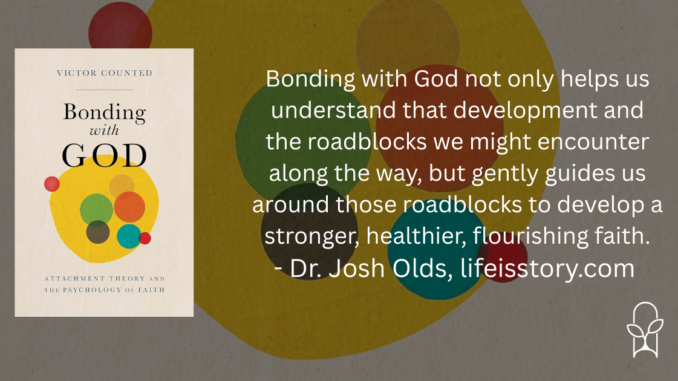
In the end, Bonding with God offers readers significant insight into our relationship with God and how we can navigate and nurture that relationship. It’s exceptionally important for pastors seeking to help others cultivate that relationship. Counted posits that Christianity is a caregiving faith. Understanding that reciprocal relationship is what fosters spiritual resilience and stronger faith formation. Our relationship with God is the most important relationship that we will ever develop. Bonding with God not only helps us understand that development and the roadblocks we might encounter along the way, but gently guides us around those roadblocks to develop a stronger, healthier, flourishing faith.