
Also by this author: The Promise, The Drummer Boy, Sinner, Green, The Dream Traveler's Quest, Into the Book of Light, The Curse of Shadownman, The Garden and the Serpent, The Final Judgment, Millie Maven and the Bronze Medallion, Nine, Millie Maven and the Golden Vial, Millie Maven and the White Sword, Millie Maven, And They Found Dragons, The Blue Boy and the Red Princess, The Light of the One, The Dragon Rider Who Saved the World, The Unknown Path
Series: The World Fixers #2
Published by Scripturo on October 1, 2025
Genres: Children's, Fiction, Fantasy
Buy on Amazon

The journey continues in The Dire Wolves and The Black Ship, as Andrew and Heidi cross the crimson sea of acid, following an ancient map Andrew hopes will lead him to his missing father—and a way to heal their divided world.
Their path leads to Courthouse Island, a strange land ruled by absurd laws, talking animals, and dangerous dire wolves. To survive, these sworn enemies must begin to trust each other.
But a deeper threat looms. A dark curse spreads across the land, cast by the mysterious Night Wizard. In just two weeks, their homeland of Cora will be lost forever—unless they can stop him.
Book two of The World Fixers begins where The Blue Boy and the Red Princess left off: Andrew and Heidi have been transported by their magic map to a place outside of Cora, on an island in the Crimson Sea. Now the map has them on a Quest and the two will follow the map while working out their differences. The two end up on a magical ship (and here, dear reader, is where we get another lengthy parenthetical narrator intrusion to insist that “magic” here doesn’t mean evil magic, because the Dekkers are marketing their books to a Christian audience of which a contingent who conflate fantasy magic with the occult, but “the same kind of magic like a wardrobe in another story you might know.”) and navigate the sea to the island of talking animals and the village of Holy.
In the village, Andrew and Heidi are confronted by a people consumed by law-keeping—and, more importantly, with punishing law-breaking. Like most of the symbolism in the series, it’s a rather ham-fisted, underwhelming, and incomplete allegory that manages to both be complex and simplistic, overly-detailed and under-explained. The obvious symbol here is that this group of people avoid hate and differences by demanding uniformity—and those who “sin” are eventually driven out of the community (or worse). Things happen and the duo barely manage to escape back to their ship and leave.
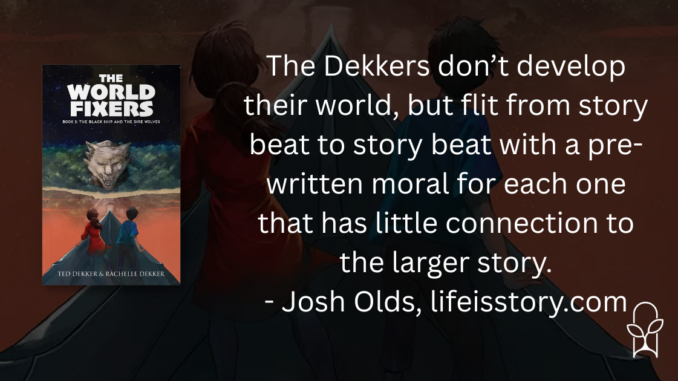
Between the ship-faring to different islands, the narrative style, the talking animals, and the direct reference to The Chronicles of Narnia, it feels like to me that the Dekkers were attempting their version of The Voyage of the Dawn Treader. Readers, this is no Chronicles of Narnia. The Dekkers don’t develop their world, but flit from story beat to story beat with a pre-written moral for each one that has little connection to the larger story. Lewis’s Narnia is a bit unhinged, but the morals and story have depth and substance, you care about the characters, the allegory drives the story but the story stands on its own. I don’t feel any of that here.
Instead, the Dekkers drop a whole different world of lore on readers. On this island, every member over the age of three wears a “purity ban”—a necklace with beads on it that number their sins. And here’s a prime example of how the Dekker’s storytelling is overly complicated and yet overly simplistic. The idea that sins are counted on a necklace is very easy to understand and a bit simplistic. But the name “purity ban” is going to feel confusing to young readers. In modern English to “ban” something means to disallow or forbid it. A purity ban sounds like one is forbidding purity—the exact opposite of what is happening. The Dekkers use the word “ban” because it comes from the Old French meaning “something that encircles or binds” (see words like “bandage” or “headband.” “Ban” is a good word for medieval fantasy literature (which this might be?) but not for this particular age group.
By the end of the book, the adventurers are back on the ship and headed out to their next unknown location. (Sidenote: The dire wolves in the title are relevant for maybe a page or two. I’m not sure why these books are titled what they are titled.) Book three, The Light of the One, will bring this story to a conclusion.