
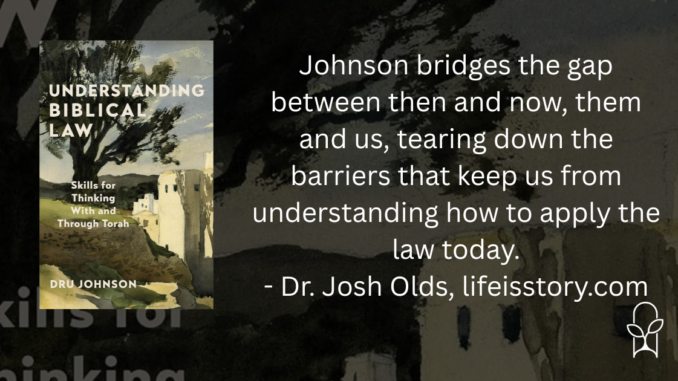
Published by Baker Academic on October 21, 2025
Genres: Non-Fiction, Theology
Buy on Amazon
Goodreads

We tend to be perplexed by the psalmists who express delight in God's laws. We see biblical law as a long list of rules with harsh punishments, and the more we read the biblical law within modern legal frameworks, the stranger it appears. We are too estranged from its world, aims, and concerns to see its beauty and wisdom.
In Understanding Biblical Law, Dru Johnson
reorients the reader to see biblical law through ancient Israelite eyes. He deconstructs common myths regarding biblical law and shows how it often differs significantly from both modern law and ancient Near Eastern law. Johnson weaves in an ancient murder mystery between chapters to show how ancient Israelites could have reasoned with and through Torah to solve real-life problems. He then demonstrates how we can do the same by discerning biblical law's literary and historical contexts, appreciating its sophisticated wisdom, and distinguishing it from our modern legal notions.This book is engaging and accessible for undergrads and laypeople but robust enough for seminarians. Johnson demonstrates a skill-based approach for interpreting Old Testament law and uses examples to encourage readers to practice these skills for themselves.
When we enter the biblical world, we see with the psalmists the beauty and sophistication of Israel's laws and discover a rich resource for thinking about the law's theological implications for Hellenistic Judaism, the New Testament, and readers today.
As a pastor and public theologian, I often run into one of two improper interpretations of the Old Testament Law. First, there are those ready to throw any part of the Law (except maybe the Ten Commandments) as an ancient law code that holds no value or spiritual significance for modern believers. Second, there are those who are ready to apply the law as written within a modern context, without much regard for historical or social context. In Understanding Biblical Law: Skills for Thinking With and Through Torah, Dr. Dru Johnson gives readers a third way—one that does justice to the text, letting us see what it meant to its original hearers.
Johnson divides Understanding Biblical Law into three parts. The first part sets up an understanding of biblical law as something different than law in our modern, western, legal sense. The Torah is not meant to be restrictive, but instructive—and its aim in not punishment but education. Some of the most profound, yet simple things that Johnson reveals is that there is no carceral system in the OT law. The focus in not incarceration but reconciliation. He spends a whole chapter busting common myths and providing readers with a correct, unbiased, and clear viewpoint to then reexamine the Law.
The second part of the book sets up the sociohistorical context, presenting Torah as both a product of its time and something much different from contemporaneous law codes. One of my favorite parts was his examination of Jewish religious festivals and rituals as part of justice formation. These rituals are there to help instruct the Israelites and form their moral imaginations and engage them in the practices of justice that will then spill over into the legal realm. Johnson also points to how many of the laws are based in a previous biblical narrative, inviting the reader into the story of Scripture to think through the laws and their potential applications.
The third part of Understanding Biblical Law then invites us as readers to apply what we have learned. Throughout the book, Johnson has paused his teaching to tell us a story. A man has been found dead outside of the city. The town has gathered together to try to solve the mystery of the death. It is soon revealed that he likely fell off a rooftop patio during the night. Who is responsible? What should the punishment be? This final part of the book allows the reader to be detective and jury as they investigate the case and determine what Torah says about this case, then invites them to reflect on other contentious aspects of the law.
Despite being a book by an academic publisher (Baker Academic) and despite its heady title, Dru Johnson has crafted a book built on accessibility. Understanding Biblical Law is meant to contextual and demystify the legal writings of an entirely different culture, written in an entirely different language, to an entirely different people group, at an entirely different time. Johnson bridges the gap between then and now, them and us, tearing down the barriers that keep us from understanding how to apply the law today.
The OT Law is a blueprint for how God would set up a community. It’s important. And it’s important that we, as Christians who have power and influence over our own communities, use that blueprint in a way that is inclusive and loving and wise. Understanding Biblical Law helps us do just that.