
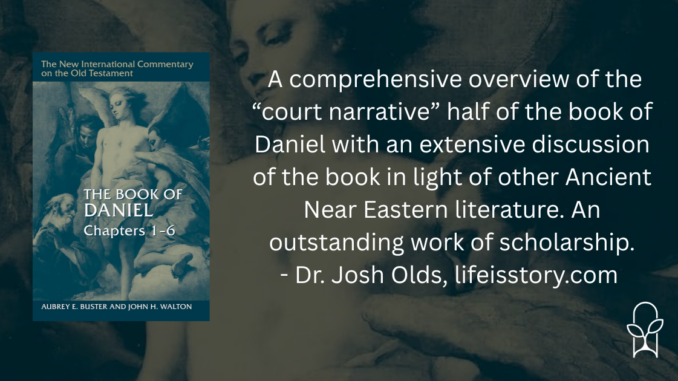
Series: NICOT
Published by Eerdmans on November 20, 2025
Genres: Academic
Buy on Amazon
Goodreads

An indispensable resource for preaching and teaching the book of Daniel
In this volume of the New International Commentary on the Old Testament, scholars Aubrey E. Buster and John H. Walton guide readers through chapters 1–6 of the book of Daniel. They provide historically informed, theologically sound interpretations of some of the most memorable stories and imagery in the Old Testament, including Daniel in the lion’s pit, the fiery furnace, the figure with feet of clay, and the writing on the wall. Buster and Walton also help readers understand the significance of the text’s composition, audience, historical context, genre, and structure. Accessible and insightful, this well-researched volume is an essential resource for preaching, teaching, and study of the book of Daniel.
All NICOT volumes combine superior scholarship, an evangelical view of Scripture as the Word of God, and concern for the life of faith today. Each volume features an extensive introduction treating the biblical book’s authorship, date, purpose, structure, and theology. The authors’ own translations of the original text and verse-by-verse commentary follow. The commentary itself carefully balances coverage of technical matters with exposition of the biblical text’s theology and implications. Readers who want to hear God’s voice anew through Scripture will find the New International Commentary on the Old Testament series to be a faithful, trustworthy guide.
Over my years as a pastor, the New International Commentary series has become my go-to Bible commentary for sermon preparation and Bible study. Written by top evangelical scholars, the series consistently takes a high view of Scripture while still doing the textual criticism necessary for accurate interpretation and application. The NIC treats Scripture like ancient history. Newer volumes in particular do an excellent job of setting the text in the context of its Ancient Near East setting and helping readers understand Scripture as literature. But they never forget that although the text is ANE literature written thousands of years ago, Scripture still speaks to us today.
The latest volume in the NIC collection is a hefty volume on the first six chapters of Daniel. Nearly 1,000 pages on just the first half of the book is probably a record. It’s noticeably thicker than Tremper Longman III’s NIVAC volume and Stephen Miller’s NAC volume combined—and both of those cover the whole of Daniel. It’s not quite the largest NICOT volume, being slightly smaller than Goldingay’s Jeremiah and deClaisse-Walford’s The Psalms. But again, this covers only half of one of the Minor Prophets.
Daniel 1-6 is written by Dr. Aubrey E. Buster and Dr. John H. Walton. Walton is one of the most-revered contemporary Old Testament scholars, best known for his work on Genesis and Job. Walton’s understanding of Genesis as functional rather than historical has been particularly influential on my own understanding of the book. Joining him is Dr. Aubrey Buster, a relative newcomer who studied under Walton in seminary and has since returned to work as an associate professor at Wheaton and collaborated with Walton on Daniel studies since at least 2022. They are the perfect example of older, established scholars and younger, upcoming scholars working together to provide the best scholarship possible.
The volume begins with an extensive bibliography and introduction. In NIC formatting, the preface and bibliography are all front matter material given lettered pagination instead of numbers. They actually manage to reach 100 pages before beginning the book, which is, again, a record among NIC volumes. Just compiling, organizing, and working with such a large bibliography is quite incredible.
After this comes a 162-page introduction going deep into the text, context, cultural setting, and composition of Daniel. In my opinion, the volume is worth its price just for this section. As the size of this commentary might indicate, Daniel is complicated. It’s written in multiple languages (Hebrew and Aramaic with Akkadian and Persian loanwords). It contains different literary genres (court drama and apocalyptic prophecy). Its setting is outside of Israel in the Babylonian Empire. There are extracanonical additions to Daniel and three different textual translation traditions. While the book often gets reduced to fodder for Sunday School (The Lion’s Den and Fiery Furnace) or dispensational preachers, Daniel’s actual breadth and depth is more complicated than maybe any other book of the Bible. Buster and Walton dive through all of that with clarity, conviction, and caution.
Among one of the most interesting conversations in this section is the discussion of when Daniel was written. The traditional view states that it was written by Daniel during his lifetime in the sixth century BC. A more critical view believes it to have been written in the second century BC by rabbinic scholars writing in Daniel’s voice basing the text on an oral tradition of Daniel’s lifetime. Obviously, this calls into question the legitimacy of Daniel’s prophetic utterances in chapters 7-12. While the authors will address this specifically in a second volume, they take the time here to question whether or not Daniel is even intended to be prophecy. The authors come down on the side of a later date, which is a bit of a shock to a conservative, evangelical audience. I can’t believe I’m saying this, but even with the book’s heft, I wish they had spent more time exploring this aspect as a fair bit of their audience is going to bristle against it. I look forward to Daniel 7-12 which will hopefully more fully engage this conversation.
After this, comes the commentary proper. Buster and Walton continue to be thorough, weaving in a plethora of excurses throughout the text. Their tone is academic but still accessible. I’m not an OT scholar or an ANE expert (I have but a humble D.Min.), but I had no problems following their line of thought even as someone not familiar with the precedent literature. That said, this work is better suited for a biblical scholar doing textual criticism than a pastor writing a sermon for Sunday morning. There’s a lot of information here, including some great applicational thoughts, but the obvious goal and tone of the work is to advance Daniel scholarship. If you’re a pastor wanting to better share this book with your congregation, Tremper Longman’s NIVAC volume is going to be a more easily accessible work.