
Also by this author: The Bible and the Ballot: Using Scripture in Political Decisions, The Book of Ecclesiastes, 2nd ed.
Published by Baker Books on September 22, 2026
Genres: Non-Fiction, Apologetics
Buy on Amazon
Goodreads

As we read through the Bible, it's common to encounter puzzling or confusing passages. This is especially the case with the Old Testament, since its time and cultural setting are so far removed from our own. It's tempting to skip over these problem passages in our personal Bible study or in our preaching and teaching. But if all Scripture is God-breathed and useful for teaching, rebuking, correcting, and training in righteousness, those passages were preserved for our benefit.
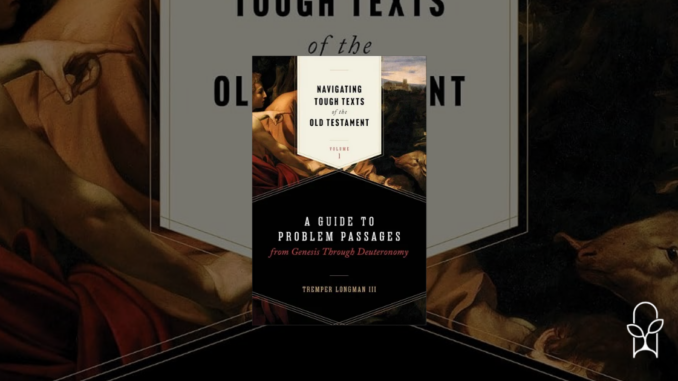
In Navigating Tough Texts of the Old Testament, volume 1 of a planned series, veteran scholar and translator Tremper Longman III guides us through difficult passages in Genesis through Deuteronomy, answering questions like
● Why are there different English translations of Genesis 1:1-2?
● Were the Hebrew midwives wrong to lie to Pharaoh?
● How do we make sense of the purity laws in Leviticus?
● What were the urim and thummim?
● and moreAlong the way, we will understand why English Bible translations differ from one another and become more confident, discerning readers of the entire Bible, not just the difficult passages.
For pastors who preach the whole Bible, students who study it seriously, and readers who have always wanted better answers to the questions they were afraid to ask, Navigating Tough Texts of the Old Testament is the guide you've been waiting for
When I was a young teenager, I absolutely loved Norm Geisler’s The Big Book of Bible Difficulties. From Genesis to Revelation, it answered apparent contradictions, gave appropriate contextualization, and offered a quickly-read and easily-accessed reference to hone my apologetical knowledge. Some twenty years later, though, I find myself not agreeing with a lot of it.
Tremper Longman III’s Navigating Tough Texts of the Old Testament (Volume 1) is a similar idea with similar execution and much different content. It answers apparent contradictions, gives appropriate contextualization, and offers a quick-reference guide to a variety of passages. The back cover copy tells readers to expect to become “a better reader of the entire Bible” and “learn to interpret difficult biblical texts.” I found myself agreeing with a lot of it. But Norm Geisler wouldn’t.
And that highlights the inherent limitation of a book like this. Difficult passages over which entire books and volumes of scholarly journal articles are written get reduced to a page or page-and-a-half of content that can effectively tell you a solution but not engage with the reasoning that led to that solution or engage with opposing viewpoints. What you are left with is basically argumentation based on trust and authority. Do you trust the author as an accurate arbiter of biblical truths? Or perhaps worded another way, does the author’s biases and theological positions already fit your own?
Now, on that front, Dr. Tremper Longman III is—in my view—someone you can trust. He is distinguished scholar and professor emeritus of Biblical Studies at Westmont College, a senior translator for the NLT, and author of more than thirty-five books on biblical interpretation. He holds a Master of Divinity from Westminster Theological and a Ph.D. in Ancient Near Eastern Languages and Literature from Yale. He has the theological background to approach the Old Testament as a theological text and the linguistics background to approach it from within its historical context.
However, get a few pages in and I think you’ll see where some folks might take issue. He says that the Bible does not speak to us about the age of the earth, that the cosmos is 13.8 billion years old, and holds the days of creation to be figurative. He says “Thus, it seems unlikely that Genesis 1 intends to tell us how God created everything or how long he took to do so.” Rather, Longman writes that the creation account was meant to challenge “all other creation accounts by proclaiming that it is Yahweh who was the Creator.”
I’m inclined to agree with Longman. But he doesn’t really give me any reasons for doing so. In similar fashion, Geisler’s volume from the 90s does the same thing from a more fundamentalist perspective. Both of these volumes can help affirm something already believed but don’t offer enough to make readers change or even question their beliefs.
While the creation account is an obvious “tough text” or “problem passage,” further in the book there are a number of entries that offer great commentary but left me wondering what the problem was. What inherent difficulty, translational contradiction, or missed context is Longman attempting to shine light upon? It’s not always clear. Part of explaining a tough text is explaining why it’s a tough text and why various Christian traditions and perspectives might take different views. Longman also skips some of the most hotly-debated “tough texts,” namely the anti-homosexuality verses in Leviticus. Surely those passages fit the bill for the book, but other than part of a single sentence acknowledging their existence in the Holiness Code, Longman does not address it.
In the end, I’m conflicted because 1) the content is good and 2) I’ve long called for popular-level mainline/progressive works to counter conservative fundamentalism. But I don’t think that the book actually accomplishes what it says it seeks to accomplish. It doesn’t teach readers how to interpret Scripture. It doesn’t navigate all the tough texts. Its brevity prevents a truly contextual conversation. I enjoy Longman’s scholarship but it’s the structure of the book itself that falls short for me. For a more substantive look at the most controversial parts of the OT, see his book Confronting Old Testament Controversies, also from Baker Books.