
Published by Eerdmans on September 9, 2025
Genres: Non-Fiction, Theology
Buy on Amazon
Goodreads

fresh theological encounter with the book of Revelation, informed by contemporary concerns and reading strategies
Greg Carey, a respected scholar of the New Testament and apocalyptic literature, shows how Revelation can speak meaningfully to today’s readers. He highlights themes in Revelation that resonate powerfully in our current era: the person of Jesus, hope in the face of death and adversity, resistance, authority, violence, gender, wealth, and more. In so doing, Carey invites readers to reconsider old assumptions about the book of Revelation and reread the text with openness to new and surprisingly contemporary insights.
Students, teachers, and pastors will find much to ponder and discuss here. Readers will come away with a deeper understanding of Revelation’s unique voice within the New Testament; an improved ability to articulate concerns and problems they may have with Revelation; and the resources they need to engage this complex book of the Bible in constructive and life-giving ways. Simply put, Carey’s Rereading Revelation is a paradigm-changing book.
I grew up in a conservative evangelical church at the height of the Left Behind craze. As a kid, I remember that the church actually fired our pastor because he was not a premillennial dispensationalist. Left Behind was the 67th book of the Bible, a helpful interpretive lens through which to view the book of Revelation. The Bible I was gifted as a six-year-old was a faux-letter KJV with study notes by dispensationalist and geologist Henry Morris. Thirty-five years later, with multiple seminary degrees and a fairly good understanding of reading Scripture contextually, I’m still grappling with how to read the book of Revelation. Rereading Revelation is exactly the book I needed.
In Rereading Revelation: Theology, Ethics, and Resistance, biblical scholar Greg Carey offers one of the most accessible yet intellectually sophisticated engagements with the Book of Revelation in recent years. Rather than reducing this complex and often misunderstood biblical book to end-times speculation or abstract prophecy, Carey invites readers to see Revelation as a theological and ethical challenge rooted in the lived realities of both John’s first-century context and our own.
Carey—professor of New Testament and a seasoned interpreter of apocalyptic literature—locates the heart of Revelation not in secret codes about the future or complex and specific charts but in its prophetic, protest voice against imperial power and systems that distort human flourishing. He carefully frames the text as counter-imperial literature. Scripture that calls the church to resist that which would demand unquestioned allegiance and that co-opts Christian loyalty for worldly power.
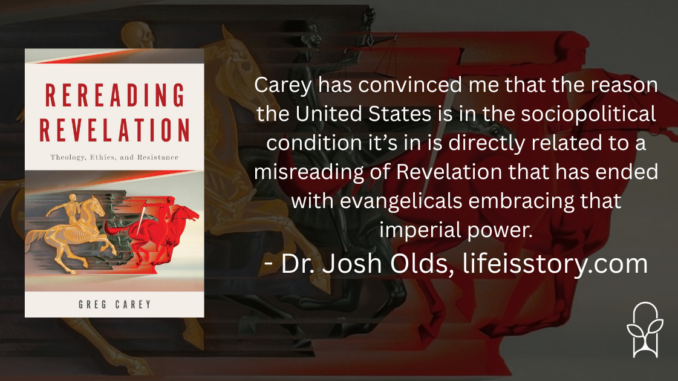
Now there’s a word for the modern evangelical church. In fact, Carey has convinced me that the reason the United States is in the sociopolitical condition it’s in is directly related to a misreading of Revelation that has ended with evangelicals instead embracing that imperial power.
Beginning with careful attention to genre, Carey shows how Revelation functions simultaneously as apocalypse, prophecy, and letter. He then moves through themes including authority and authoritarianism, the portrayal of Jesus, wealth and poverty, emotion and affect, violence and judgment, and even questions of gender and identity. Each chapter seeks not just to explain the text but to relate it ethically to contemporary Christian life.
If there is a weakness (and it would be unfair to call this a real weakness), it’s that Carey does not defend his position of Revelation as an ethical, anti-empire text against the more popular interpretations. That is not at all his goal or priority, but I think it would leave some folks who have grown up with a much different reading of Revelation unsure of what then to do with that reading they grew up with. But overall, this is a powerful, transformative work. I’m going to have to read it again to truly grasp all of what Carey is saying.