
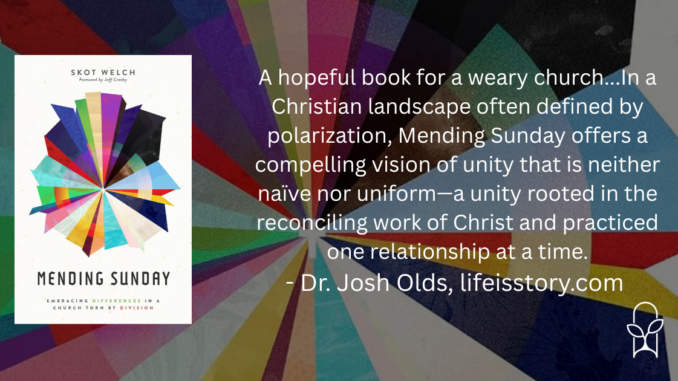
Published by Herald Press on March 31, 2026
Genres: Non-Fiction, Christian Life
Buy on Amazon
Goodreads

Diversity is God's idea--and unity is how we honor God.
Our heavenly Father calls us to unite, but Christians remain some of the most divided people on the planet. It seems we mistake God's call for unity as a command for uniformity: We split along political and denominational lines and prefer our churches, neighborhoods, and other spaces to be filled with those most "like" ourselves.
Our segregated habits may satisfy our need for comfort, but division breaks God's heart. We are called to embrace the miracle of unity, when what was once separated due to difference comes together--when people from every group, nation, and tongue praise the name of Jesus.
In Mending Sunday, Skot Welch offers a pathway for putting on the mind of Christ when it comes to diversity and division. God's unity doesn't mean giving up our unique identities and the gifts of ethnicity, family, language, or tradition. Rather, when we put Jesus at the center of our lives and communities, we experience a grace and power we've never before known. In a culture bent on division, a church that embraces differences becomes the biggest witness for Christ the world has ever seen.
If there is one word that defines much of the modern church, it may be fragmentation. Congregations divide over politics, race, worship styles, theology, and social issues. Christians increasingly sort themselves into communities of like-minded people, often mistaking uniformity for unity. In Mending Sunday, Skot Welch offers a timely reminder that the gospel calls believers to something far more demanding: reconciliation across difference.
Welch writes from extensive experience as a bridge-builder in both ministry and organizational leadership, and that practical background shapes the book’s tone. Mending Sunday is less interested in diagnosing who is right in today’s cultural conflicts than in asking how Christians can remain faithfully connected when they disagree. Rather than treating division as an unfortunate byproduct of conviction, Welch argues that learning to love across differences is itself an essential expression of Christian discipleship.
The book’s central insight is both simple and challenging. Diversity within the body of Christ is not a problem to solve but a gift to steward. Welch encourages readers to move beyond debates that seek winners and losers toward conversations grounded in curiosity, humility, and mutual respect. Drawing on biblical themes of reconciliation, hospitality, and the unity of the church, he reminds readers that Christian community has always required people from vastly different backgrounds to learn how to worship, serve, and grow together.
One of the book’s greatest strengths is its refusal to reduce reconciliation to mere civility. Welch recognizes that genuine unity cannot be achieved by ignoring injustice or pretending disagreements do not matter. Instead, he emphasizes the hard work of listening well, acknowledging pain, confronting prejudice, and extending grace. His vision is not one of superficial harmony but of relationships transformed through intentional practices of empathy and trust.
That practical focus makes Mending Sunday especially valuable for pastors, ministry leaders, and congregations navigating seasons of conflict. Welch offers principles that are broadly applicable without becoming formulaic. The discussion questions and reflective exercises encourage readers to examine not only the divisions around them but also the assumptions and fears they themselves bring into difficult conversations.
At times, readers hoping for deeper engagement with specific theological or cultural flashpoints may wish Welch ventured further into the complexities. The book generally prioritizes principles over detailed case studies, making it accessible to a broad audience but occasionally leaving difficult questions unresolved. Yet that restraint also serves the book’s larger purpose. Welch is less interested in settling every debate than in cultivating the character necessary to have those debates faithfully.
Ultimately, Mending Sunday is a hopeful book for a weary church. It acknowledges that disagreement is inevitable but insists that division is not. Welch invites readers to imagine congregations where differences become opportunities for growth rather than reasons for separation. In a Christian landscape often defined by polarization, Mending Sunday offers a compelling vision of unity that is neither naïve nor uniform—a unity rooted in the reconciling work of Christ and practiced one relationship at a time.