
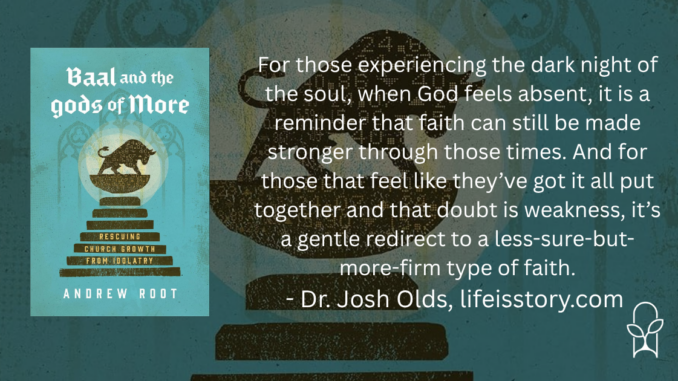
Published by Baker Academic on April 21, 2026
Genres: Non-Fiction, Christian Life
Buy on Amazon
Goodreads

In an era of church decline, pastors and ministry leaders face intense pressure to grow--more attendance, more influence, more reach, more budget. But what if this relentless pursuit of "more" is actually a form of modern idolatry?
In Baal and the Gods of More, leading practical theologian Andrew Root challenges everything you thought you knew about church growth and success. You'll discover how to
● identify the hidden idolatry embedded in modern church growth strategies and learn why bigger isn't always better in God's kingdom;
● understand the historic roots of America's church growth obsession through economic theory, cultural philosophy, and the industrial revolution's lasting impact;
● break free from toxic comparison and the exhausting cycle of innovation, influence-seeking, and numbers-driven ministry that's burning out church leaders;
● rediscover biblical wisdom from 1 and 2 Kings that reveals how ancient Israel's fertility god worship mirrors today's church growth addiction; and
● embrace a radical alternative focused on divine action, relational encounter, and theological depth.Root reveals how Protestant churches have become dangerously dependent on growth-driven stabilization, a mindset inherited from the industrial revolution's golden era. He draws striking parallels between ancient Israel's worship of Baal and other fertility gods and the contemporary church's obsession with expansion. Just as the Israelites turned to false gods promising abundance, today's church often looks to secular methodologies, innovation strategies, and growth techniques as saviors.
This provocative book argues that creativity, innovation, and endless strategizing won't save declining churches. Instead, Root calls the church back to dependence on divine action and genuine relational encounter with the Word of God.
Perfect for pastors, church leaders, students, and anyone concerned about authentic ministry in a post-Christian culture, this book offers a theologically grounded path forward that trades growth metrics for God's presence.
If you take a look at church growth trends, you’ll see an interesting and disturbing movement. While small and community churches are dying, megachurches are growing. The overall pool of Christians is stagnant (that’s a metaphor that works in a number of ways), but are becoming concentrated in bigger churches. I experienced this through a friend several years ago. He was a youth pastor at a community church when a megachurch opened up a satellite campus literally across the street. They imported their volunteers, their staff, their financial resources, and their way of doing things. And within a couple of years, the community church closed. They just couldn’t compete with the accessibility and resources the megachurch required.
Baal and the gods of More is an exploration and critique of exactly this phenomenon. Andrew Root argues that church growth has become an idol with the church shaped in the form of American consumerism. Our bigger is better mentality allows us to farm out the work of the church to professionals. It draws us into a technically precise, eminently entertaining, emotionally manufactured experience—but can leave us devoid the relationality that truly creates the church.
Root makes his case through six chapters. The first sets up the church as a resistance to unchecked growth. He gives a biblical example of the unchecked excesses of the prophets of Baal, but the most compelling example he gives is a contrast between a statue of the Greek goddess Artemis and representations of Mary the mother of Jesus. He shows an image of Artemis, portrayed as a powerful god covered in breasts: “Artemis called that power with in production,” he writes, “in the excess of resources, in the capacity to grow without end.” With Mary, conversely, we see her pictured as a loving mother embracing her child. Their relationship is not about consumption, but love. That, Root says, is the root of the church growth problem.
With the foundation set, Baal and the gods of More turns to examine the church growth and megachurch movements to see how the modern church has favored consumption over relationship. It’s an incisive and comprehensive argument that, incidentally, also serves a critique of the social and economic systems the church is basing its ministries on.
In the end, Root calls us away from a faith built on modern economic growth principles and toward a smaller, more intimate, relational faith in Jesus. It’s an indictment of the bigger-is-better philosophy and a reminder to close in small churches that their communities matter and that their future is set not in giving into commercialism and consumption, but finding health in Jesus.