
Also by this author: The Promise, The Drummer Boy, Sinner, Green, The Dream Traveler's Quest, Into the Book of Light, The Curse of Shadownman, The Garden and the Serpent, The Final Judgment, Millie Maven and the Bronze Medallion, Nine, Millie Maven and the Golden Vial, Millie Maven and the White Sword, Millie Maven, And They Found Dragons, The Blue Boy and the Red Princess, The Light of the One, The Dragon Rider Who Saved the World, The Unknown Path
Series: The Dragon Rider Who Saved the World #3
Published by Scripturo on October 22, 2024
Genres: Children's, Fiction, Fantasy
Buy on Amazon

In the gripping conclusion of the Dragon Rider series, the Guardians are scattered and all hope is lost. Emilia and Oliver are forced to seek out an alliance with a deadly enemy, the Scalers, who live deep in the desert. Their only hope is to join with that enemy and directly confront the much larger armies of the Order in one final battle. Their only advantage is the golden dragon, Darrian.
But Darrian is an unusual dragon with his own mind.
And the Order has a new secret weapon that will easily crush any army.
Rise of the Firewalker brings The Dragon Rider trilogy to it conclusion as the Order hunts Emilia and her dragon, forcing Emilia to seek out an unlikely—and perhaps unwise—ally. Seeing the massive forces of Capital City, Emilia turns to the Marauders—descendants of the dragon-worshipping Scalers—for help. In turn, she, Darrian (the dragon), and their friend Oliver are all imprisoned by the king as he thinks over Emilia’s request for an alliance.
This plot point didn’t really make a whole lot of sense to me. You could easily take the Marauders out of the story and not really affect the plot in any way. The Dekkers seemingly love to add in third-parties that are symbolically adjacent to their two main factions as it’s a recurring feature in their books. Here, though, the Marauders don’t play a compelling role other than to provide some level of intrigue before the book’s climax. It’s also here—by connecting them to the Scalers of The Dragons Among Us—that the Dekkers remind us of the way dragons work in their established universe and how they’re just basically ignoring that this time around. The end result is a lot of story that adds content but not substance.
When the climax does come around, it just sort of—by nature—fizzles. The alliance with the Marauders doesn’t go anywhere because Emilia determines that violence is not the answer and refuses to fight. Darrian, the dragon, goes full Aslan and offers himself up as a sacrifice to Capital City. Despite that imagery, the Dekkers don’t set it up well, or engage with it at any length or with substance. Readers who get the Jesus metaphor are going to understand but young children—even if they know the Jesus story—might not follow. But maybe that’s for the best, because Darrian doesn’t come back. He stays dead. So, we have this prophesied dragon who does basically nothing and then lays down at the end of his enemy, dies, and that’s it except for some Stars Wars-esque force ghost type imagery.
In the climax, the Dekkers remember that dragons are only a manifestation of fear, so Capital City’s dragon queen disappears into a mist when Emilia says “No more.” From the book:
“The dragon queen was gone, turned into nothing. But of course, because the dragon queen was fear itself, and fear was ultimately an illusion. That illusion could not remain in the face of love. It didn’t even exist.”
This fear-as-illusion theme is the central theme of all the Dekkers’ dragon books. Yet this appears to be the best they can explain it. It’s emotionally and narratively unsatisfying—not to mention garbled and grammatically incorrect. Dragon goes poof when MC knows God’s love is a great symbol. It’s less satisfying as the climax to a story.
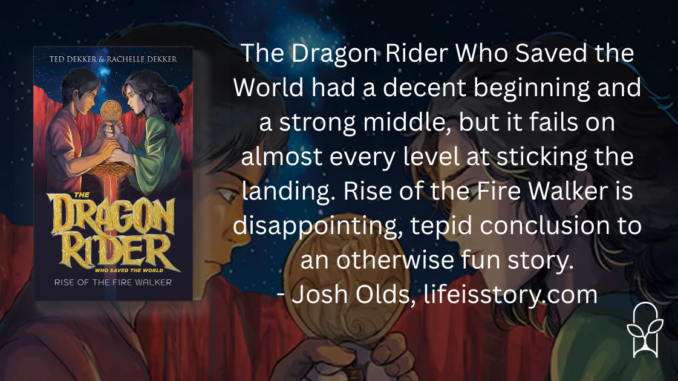
The Dragon Rider Who Saved the World had a decent beginning and a strong middle, but it fails on almost every level at sticking the landing. Rise of the Fire Walker is disappointing, tepid conclusion to an otherwise fun story.