
Published by Eerdmans on August 20, 2026
Genres: Disability Theology, Non-Fiction, Leadership, Theology
Buy on Amazon
Goodreads

Learn how to preach on disability―and why doing so can be transformative for everyone.
Disability appears throughout Scripture, yet most pastors lack the tools to preach about it with confidence and sensitivity. In Preaching Disability: A Resource for Pastors, Bill Gaventa fills this critical gap with wisdom gleaned from decades working at the intersection of faith and disability.
This groundbreaking guide helps clergy move beyond harmful stereotypes―disability as punishment for sin, disability as inspiration―toward preaching that honors the full humanity and spiritual depth of people with disabilities. Gaventa reveals how listening to their stories unlocks biblical themes that are relevant to everyone.
Whether you’re preparing a sermon on a passage involving disability, leading an inclusive ministry, or simply wondering how to address this aspect of human experience authentically, this resource offers:
Practical guidance for preaching biblically and sensitively about disability
Fresh insights into disability’s ubiquitous presence in Scripture
An introduction to the broader literature on theology and disabilityPerfect for pastors, seminary students, and church leaders, Preaching Disability is the first book focused on disability in the context of pulpit ministry. Accessible, engaging, and substantial enough to serve as an ongoing reference, it prepares ministers to welcome people with disabilities fully―and in so doing, to illuminate spiritual truths for the entire congregation.
Everyone will experience disability at some point, in some way, during their life. The CDC reports that more than 1 in 4 adults in the United States (roughly 60 million people) live with a disability. And yet I have heard pastors say things like “Well, we don’t have any disabled people in our church.” Either this is false, which means the pastor isn’t engaged enough in their congregation, or it’s true—which is somehow even worse. It is a professional and moral necessity that pastors and church leaders be able to appropriately speak about disability. And Bill Gaventa’s Preaching Disability is a great sourcebook for doing so.
Gaventa is the founder and director emeritus of the Institute on Theology and Disability. He’s served as a chaplain for those with developmental disabilities and spent most of his career as Director of Community and Congregational Supports for the Elizabeth M. Boggs Center, an institution that provides support for those with disabilities. While Gaventa is academically and theologically trained to write a book like this, he’s also lived it out practically.
The opening chapter focuses on the language we use to discuss disability. This is such an important opener. Most of us aren’t aware of the ableist and anti-disability language and metaphor that can litter our Christian speech. Disability as a metaphor for sin or separation from God is common—“I once was blind, but now I see”—and pastors should be careful that their explanation of a spiritual concept does not do harm to others through how that concept is expressed.
Gaventa then talks about instances of disability in Scripture. Most interesting to me was the speculation that Joseph could have been Autistic. He talks about how even God is described as using a wheelchair in Ezekiel. It’s an eye-opening look at Scripture and the people within it that we often miss simply because the word “disability” isn’t used.
The bulk of the book is spent on developing a disability-minded paradigm and practically working that out within church ministry. Preaching Disability goes through topics like lamenting disability, accommodating various needs, recognizing the leadership abilities of those who are disabled, and more. Gaventa walks readers through accepting those with disabilities into the community of church. Then, he moves from acceptance to understanding, then from understanding to engagement. It’s not enough just to let “them” in the door, they must become part of “us” and have their abilities (not just their disabilities) recognized and utilized within the church.
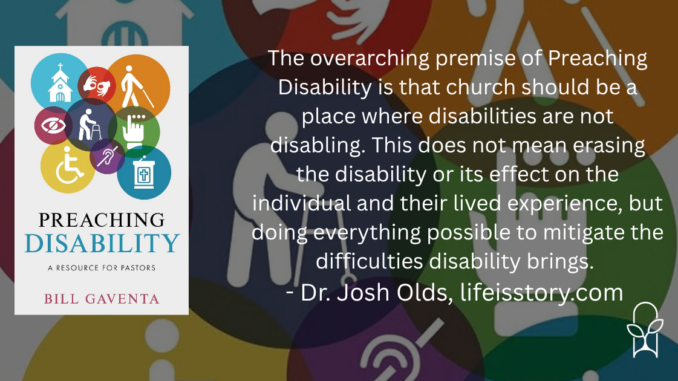
The overarching premise of Preaching Disability is that church should be a place where disabilities are not disabling. This does not mean erasing the disability or its effect on the individual and their lived experience, but doing everything possible to mitigate the difficulties disability brings. Gaventa leads readers into a theology of inclusion and love that recognizes the unique value and unique needs of every individual in the church.