
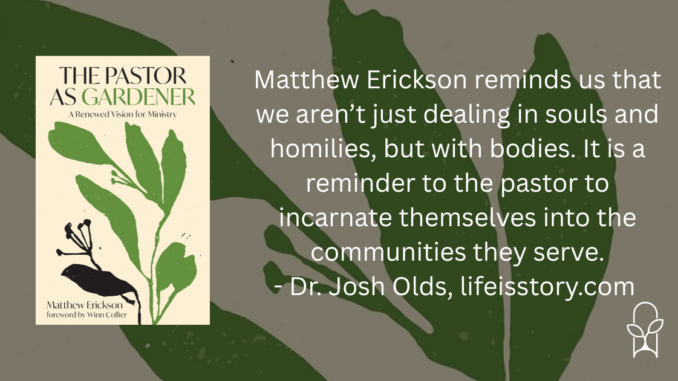
Published by Eerdmans on March 24, 2026
Genres: Non-Fiction, Leadership
Buy on Amazon
Goodreads

A restorative, life-giving vision of pastoral work
In times of confusion and chaos, people often find that their path to wholeness runs through a garden. Tending plants and tilling soil are timeless, restorative acts that can renew our sense of identity and purpose. In The Pastor as Gardener, Matthew Erickson taps into this truth and applies it to the work of pastoral ministry.
Writing for clergy who question whether meaningful ministry is possible in our current cultural context, Erickson encourages pastors to reframe their vocation as the work of a gardener. Bringing together Scripture and practical theology, he shows how gardening metaphors offer new ways of thinking about critical issues in pastoral work: effectiveness, humility, hospitality, and more. Readers will come away with a deeper appreciation for their ministry environment, a better understanding of the stages of growth in the pastoral life, and an increased ability to persevere in ministry even when fruit is not immediately apparent.
Nuanced and insightful, The Pastor as Gardener will appeal to readers who appreciate the pastoral wisdom of Eugene Peterson and the agrarian sensibilities of Wendell Berry. For ministers seeking a sense of vocation that is deeply rooted but also dynamic, this book is essential reading.
The word “pastor” is a word from nature. It comes from the Latin noun for “shepherd” which derives from a verb meaning “to lead to pasture” or “to feed.” Earliest usage of “pastor” in English was literal. It meant a shepherd. By the 1500s, the word was being used metaphorically to mean spiritual leaders who care for and guide a church congregation. In The Pastor as Gardener, Matthew Erickson offers a similar and related metaphor: What might viewing the pastor as a gardener change in our perspective of ministry?
The imagery of the Christian life—and the Christian community—as a garden is embedded throughout Scripture. Jesus often uses agrarian imagery. He calls himself the “true vine” and speaks of grafting Gentiles into the community of faith. Paul talks about evangelism and discipleship as being done by a series of pastor-gardeners—“I sowed, Apollos watered, God has gathered the increase.”
Much of Erickson’s work in The Pastor as Gardener is simply to explore that metaphor throughout Scripture and identify similarities and connections between the work of a gardener and the work of a spiritual leader. He meanders—I think that is a good term to describe it and befitting the gardening metaphor—through the Scriptures and through the writings of other church leaders to develop the perspective of a pastor as someone who tends, nurtures, plants, transplants, prunes, and rejoices over their garden.
The chapter I found most helpful and encouraging personally was Erickson’s writing about the cyclical nature of seasons and embracing those seasons as being a pastor-gardener. The work of a gardener shifts as seasons change: what they plant, how they care for the plants they have, and so on. As pastors, we also need to embrace the cyclical and changing nature of ministry. How we minister and to whom we minister will change over seasons. The Pastor as Gardener is able to draw that concept out and gently remind pastors that we are to respond to the needs of our work, not get locked into “our way” of doing things.
Overall, The Pastor as Gardener is a helpful, hopeful, optimistic book. I am not a gardener, nor do I have any inclination to want to be one. But I do love being a pastor, and this book made me wonder if I shouldn’t go out and plant some flowers. I guess that’s my endorsement of this book. The Pastor as Gardener was written to help pastors (and laypeople) understand the work of the pastor in more accessible, natural terms. It grounds the spiritual work of the pastor in the embodied, earthly realities. It reminds us that we aren’t just dealing in souls and homilies, but with bodies. It is a reminder to the pastor to incarnate themselves into the communities they serve.